Accountant Job Description Who Prepare Trial Balance for the Review
Analyzing and Recording Transactions
17 Prepare a Trial Rest
Once all the monthly transactions have been analyzed, journalized, and posted on a continuous twenty-four hours-to-day footing over the accounting period (a calendar month in our example), we are prepare to start working on preparing a trial balance (unadjusted). Preparing an unadjusted trial balance is the 4th footstep in the bookkeeping wheel. A trial rest is a list of all accounts in the general ledger that have nonzero balances. A trial balance is an of import pace in the accounting procedure, because it helps identify any computational errors throughout the first 3 steps in the cycle.
Notation that for this step, we are considering our trial balance to be unadjusted. The unadjusted trial balance in this section includes accounts earlier they have been adjusted. As you see in step vi of the accounting cycle, nosotros create some other trial rest that is adapted (come across The Adjustment Procedure).
When constructing a trial residuum, we must consider a few formatting rules, akin to those requirements for financial statements:
- The header must contain the proper noun of the company, the label of a Trial Residual (Unadjusted), and the engagement.
- Accounts are listed in the accounting equation order with assets listed first followed by liabilities and finally equity.
- Amounts at the top of each debit and credit column should have a dollar sign.
- When amounts are added, the final figure in each column should exist underscored.
- The totals at the end of the trial residue demand to have dollar signs and be double-underscored.
Transferring information from T-accounts to the trial rest requires consideration of the last balance in each account. If the concluding balance in the ledger business relationship (T-account) is a debit residuum, you will record the total in the left column of the trial residue. If the final balance in the ledger account (T-business relationship) is a credit balance, you volition record the total in the right column.
Once all ledger accounts and their balances are recorded, the debit and credit columns on the trial balance are totaled to see if the figures in each column match each other. The final total in the debit cavalcade must be the aforementioned dollar amount that is adamant in the terminal credit column. For case, if you determine that the last debit balance is $24,000 and then the final credit balance in the trial rest must also be $24,000. If the 2 balances are not equal, there is a mistake in at least 1 of the columns.
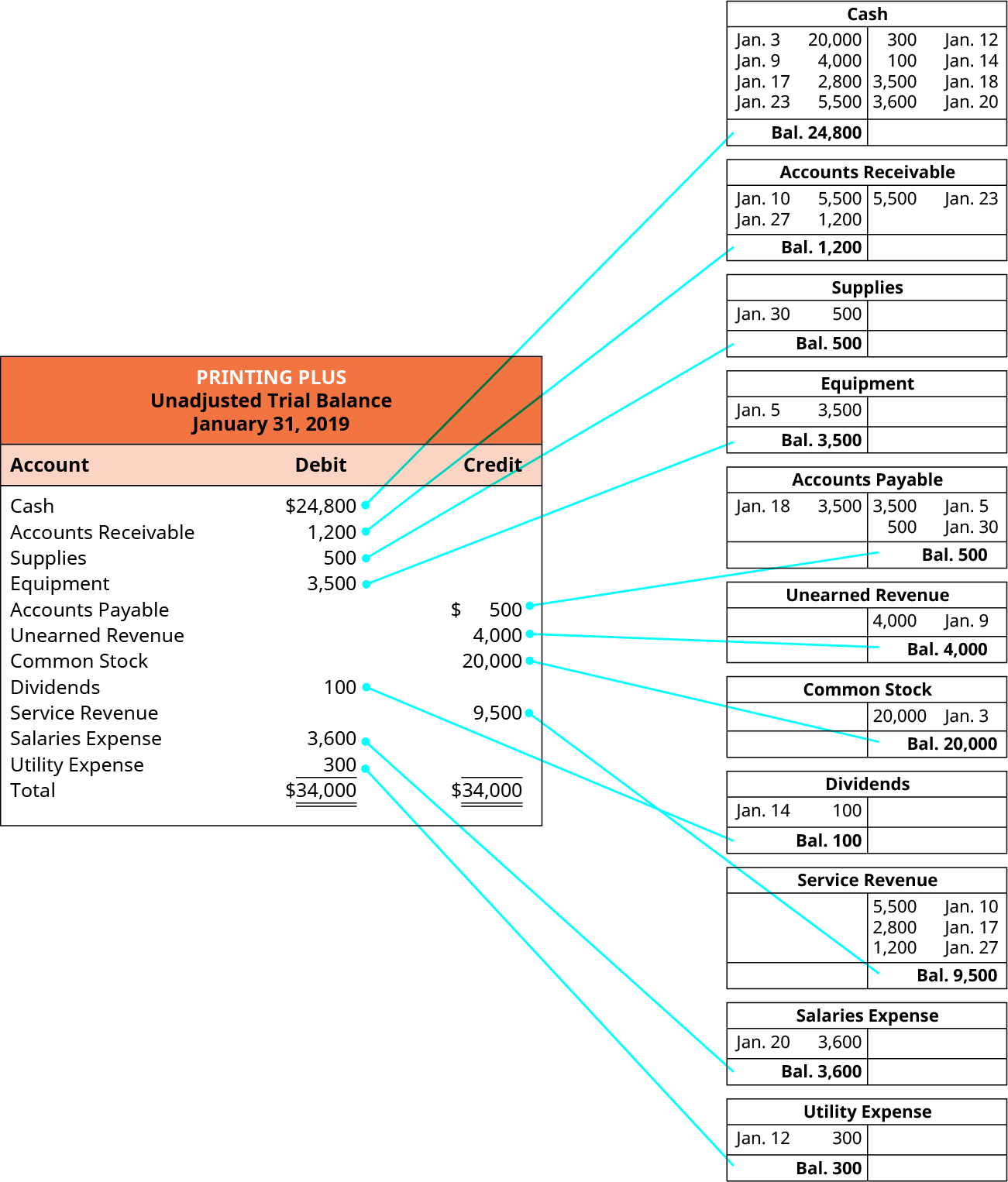
Let's now accept a look at the T-accounts and unadjusted trial balance for Printing Plus to run into how the information is transferred from the T-accounts to the unadjusted trial balance.
For example, Cash has a concluding residue of $24,800 on the debit side. This residue is transferred to the Cash business relationship in the debit column on the unadjusted trial balance. Accounts Receivable ($1,200), Supplies ($500), Equipment ($iii,500), Dividends ($100), Salaries Expense ($3,600), and Utility Expense ($300) as well have debit final balances in their T-accounts, so this data will be transferred to the debit column on the unadjusted trial residuum. Accounts Payable ($500), Unearned Revenue ($iv,000), Common Stock ($20,000) and Service Acquirement ($nine,500) all have credit final balances in their T-accounts. These credit balances would transfer to the credit cavalcade on the unadjusted trial rest.
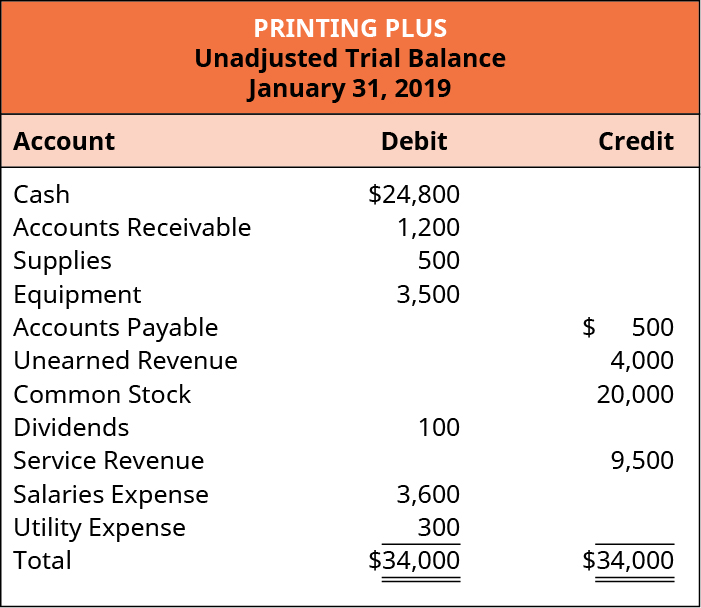
In one case all balances are transferred to the unadjusted trial balance, we will sum each of the debit and credit columns. The debit and credit columns both total $34,000, which ways they are equal and in residuum. All the same, just because the column totals are equal and in remainder, we are nevertheless not guaranteed that a mistake is non present.
What happens if the columns are not equal?
Enron and Arthur Andersen
I of the well-nigh well-known financial schemes is that involving the companies Enron Corporation and Arthur Andersen. Enron defrauded thousands by intentionally inflating revenues that did not exist. Arthur Andersen was the auditing firm in charge of independently verifying the accuracy of Enron'due south financial statements and disclosures. This meant they would review statements to make sure they aligned with GAAP principles, assumptions, and concepts, amongst other things.
It has been alleged that Arthur Andersen was negligent in its dealings with Enron and contributed to the collapse of the company. Arthur Andersen was brought upwards on a charge of obstruction of justice for shredding of import documents related to criminal actions by Enron. They were establish guilty just had that confidence overturned. However, the damage was done, and the company's reputation prevented it from operating as it had.1
Locating Errors
Sometimes errors may occur in the accounting process, and the trial balance can make those errors apparent when it does not rest.
One way to observe the fault is to take the difference between the two totals and dissever the difference by two. For example, allow'southward assume the following is the trial residual for Press Plus.
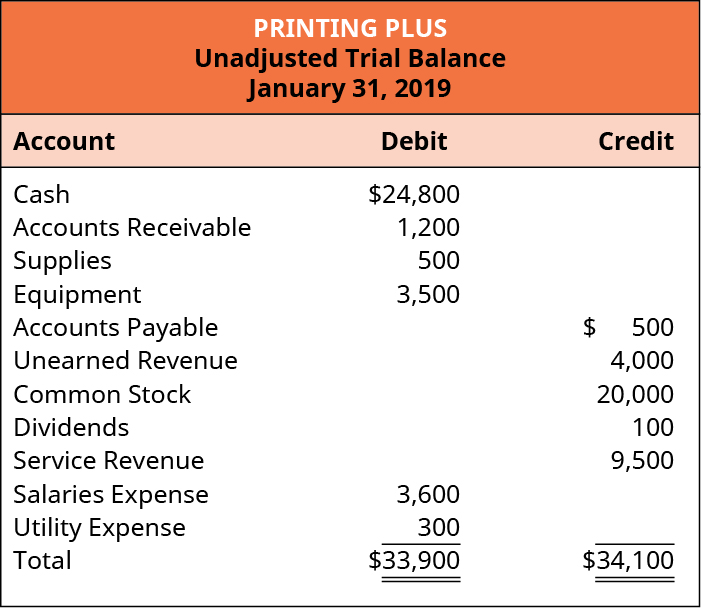
You lot notice that the balances are non the same. Detect the difference between the ii totals: $34,100 – $33,900 = $200 difference. Now split up the difference past two: $200/2 = $100. Since the credit side has a college total, wait carefully at the numbers on the credit side to run into if any of them are $100. The Dividends account has a $100 figure listed in the credit column. Dividends normally have a debit residue, but here it is a credit. Await back at the Dividends T-account to see if it was copied onto the trial residuum incorrectly. If the answer is the same equally the T-account, and so trace it back to the journal entry to check for mistakes. You lot may discover in your investigation that you copied the number from the T-account incorrectly. Fix your error, and the debit total will go up $100 and the credit total down $100 so that they will both at present exist $34,000.
Another mode to detect an fault is to take the divergence between the two totals and divide past nine. If the upshot of the divergence is a whole number, then y'all may take transposed a figure. For example, let's assume the following is the trial balance for Printing Plus.
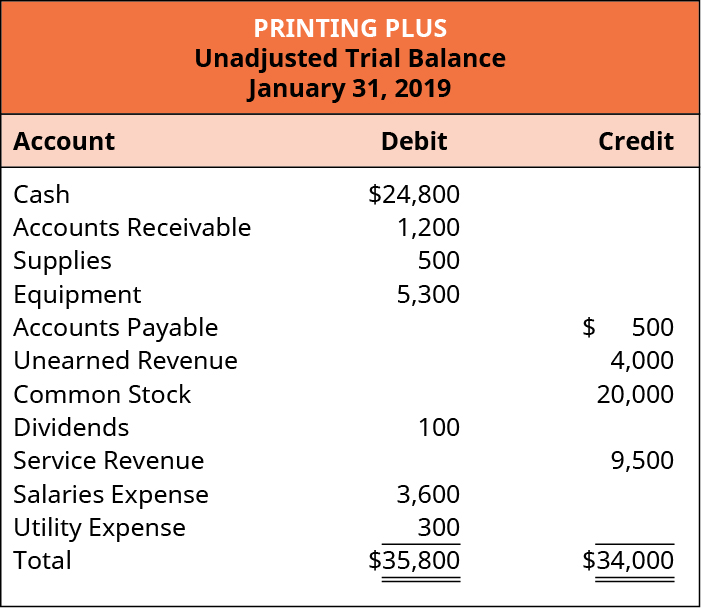
Discover the difference between the 2 totals: $35,800 – 34,000 = $ane,800 difference. This difference divided by 9 is $200 ($1,800/nine = $200). Looking at the debit cavalcade, which has the higher total, nosotros determine that the Equipment business relationship had transposed figures. The business relationship should be $3,500 and not $5,300. Nosotros transposed the three and the five.
What do you exercise if you lot take tried both methods and neither has worked? Unfortunately, you volition have to go back through one step at a time until you detect the error.
If a trial remainder is in residue, does this hateful that all of the numbers are correct? Not necessarily. We can have errors and still exist mathematically in balance. It is important to go through each step very carefully and recheck your work oft to avoid mistakes early in the process.
After the unadjusted trial residual is prepared and it appears mistake-free, a company might look at its fiscal statements to go an idea of the company'due south position earlier adjustments are fabricated to certain accounts. A more than complete picture of visitor position develops after adjustments occur, and an adjusted trial remainder has been prepared. These next steps in the accounting cycle are covered in The Adjustment Procedure.
Completing a Trial Balance
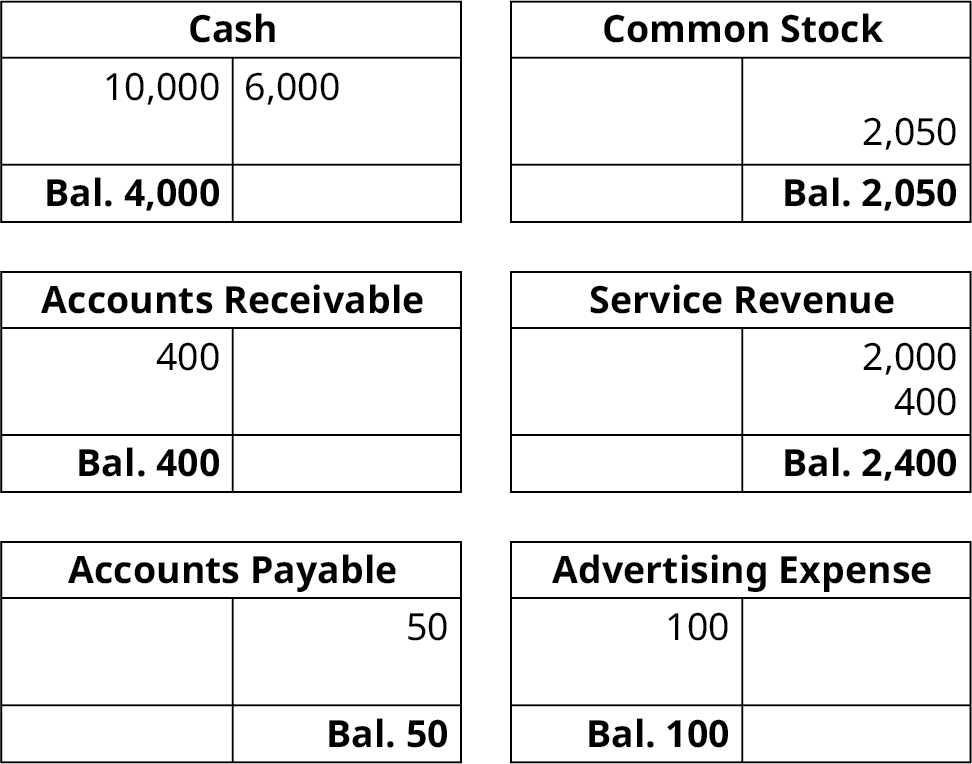
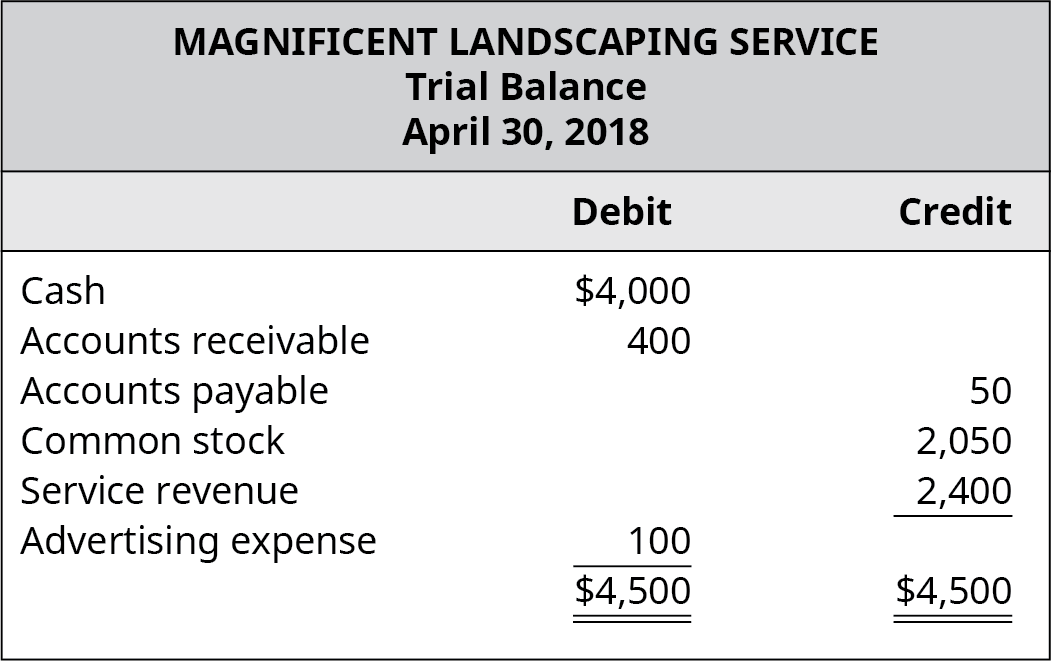
Complete the trial residue for Magnificent Landscaping Service using the following T-account terminal residuum information for April thirty, 2018.
Solution
Correcting Errors in the Trial Remainder
You ain a small consulting business. Each month, you prepare a trial balance showing your company's position. Afterward preparing your trial residue this month, you discover that it does not balance. The debit column shows $2,000 more dollars than the credit column. Y'all decide to investigate this error.
What methods could yous use to find the mistake? What are the ramifications if you do not observe and set this error? How can y'all minimize these types of errors in the hereafter?
Key Concepts and Summary
- The trial balance contains a listing of all accounts in the general ledger with nonzero balances. Data is transferred from the T-accounts to the trial residuum.
- Sometimes errors occur on the trial residual, and there are ways to find these errors. One may accept to go through each footstep of the accounting process to locate an error on the trial balance.
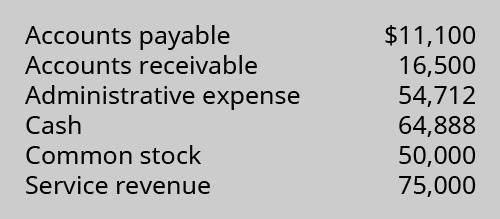
Do Set A
(Figure)Prepare an unadjusted trial remainder, in correct format, from the alphabetized account information as follows. Presume all accounts have normal balances.
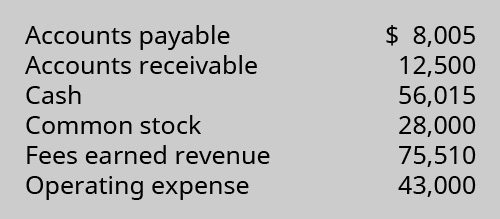
Practise Set B
(Figure)Set an unadjusted trial residue, in right format, from the alphabetized account data every bit follows. Assume all accounts have normal balances.
Problem Fix A
(Figure)Prepare an unadjusted trial residue, in correct format, from the following alphabetized account information. Assume accounts have normal balances.
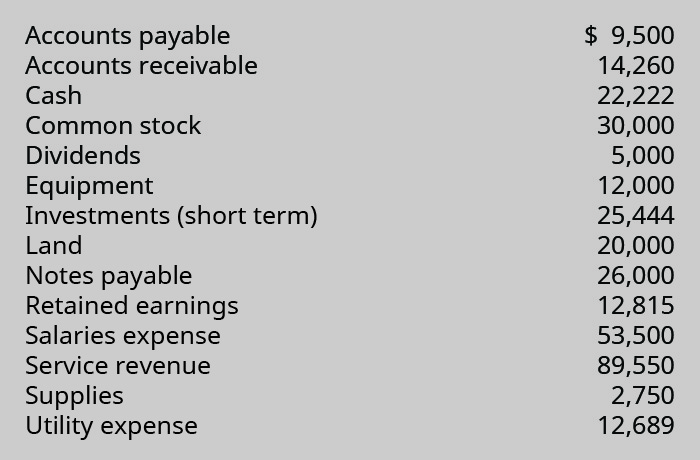
(Figure)Prepare an unadjusted trial balance, in right format, from the following alphabetized account information. Presume all the accounts have normal balances.
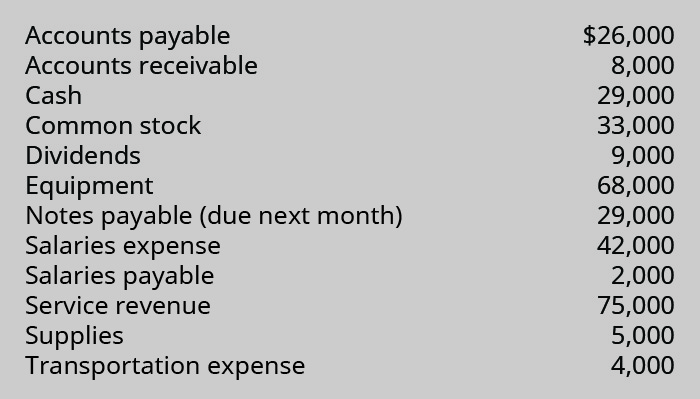
Problem Set B
(Effigy)Prepare an unadjusted trial residual, in right format, from the following alphabetized account information. Assume all accounts have normal balances.
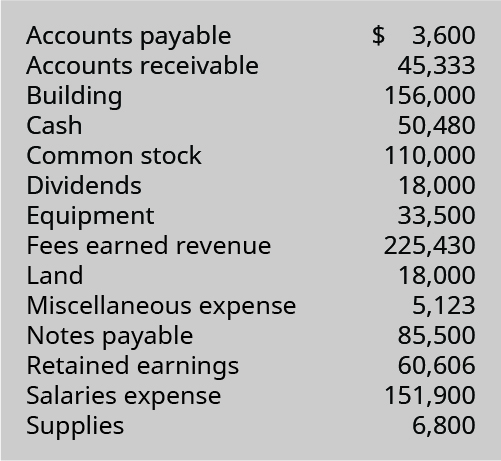
(Effigy)Ready an unadjusted trial residual, in correct format, from the following alphabetized account data. Presume all accounts take normal balances.
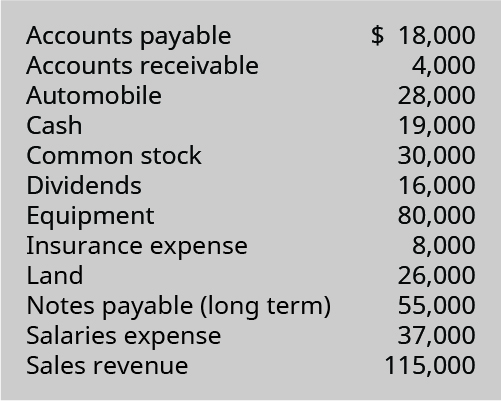
Thought Provokers
(Effigy)Analyze Trusty Company's trial residue and the additional data provided to determine the post-obit:
- what is causing the trial balance to be out of balance
- any other errors that require corrections that are identified during your assay
- the effect (if any) that correcting the errors will have on the bookkeeping equation
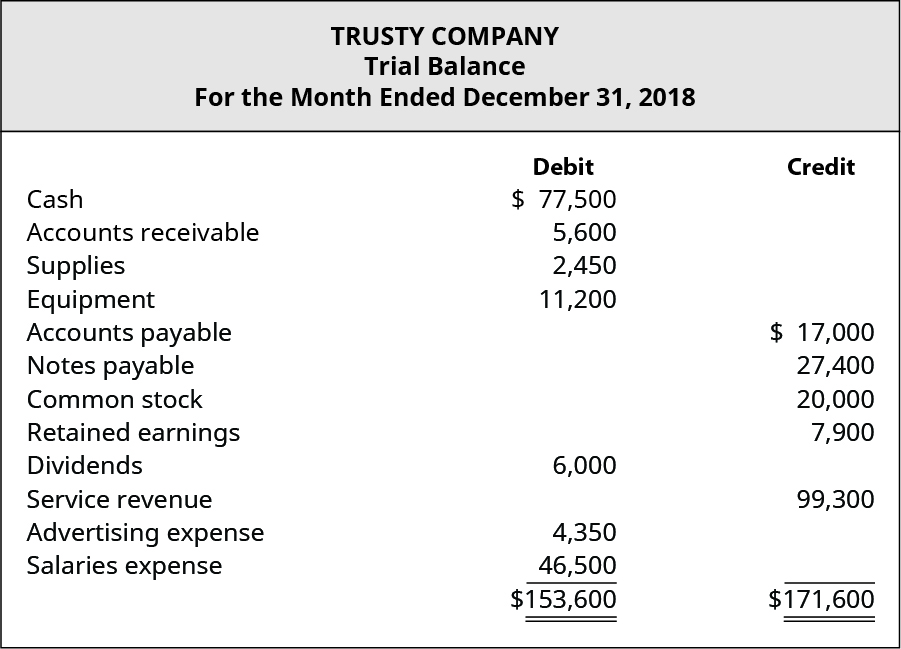
A review of transactions revealed the following facts:
- A service fee of $18,000 was earned (but not withal collected) by the end of the catamenia just was accidentally not recorded as revenue at that time.
- A transposition error occurred when transferring the account balances from the ledger to the trial balance. Salaries expense should accept been listed on the trial residue every bit $64,500 but was inadvertently recorded as $46,500.
- Two machines that cost $9,000 each were purchased on account but were not recorded in company accounting records.
Footnotes
- 1 James Titcomb. "Arthur Andersen Returns 12 Years afterward Enron Scandal." The Telegraph. September ii, 2014. https://www.telegraph.co.great britain/finance/newsbysector/banksandfinance/11069713/Arthur-Andersen-returns-12-years-after-Enron-scandal.html
Glossary
- trial remainder
- listing of all accounts in the general ledger that have nonzero balances
- unadjusted trial residuum
- trial residual that includes accounts before they have been adapted
Source: https://opentextbc.ca/principlesofaccountingv1openstax/chapter/prepare-a-trial-balance/
0 Response to "Accountant Job Description Who Prepare Trial Balance for the Review"
Post a Comment