Deforestation in the Amazon From Beef
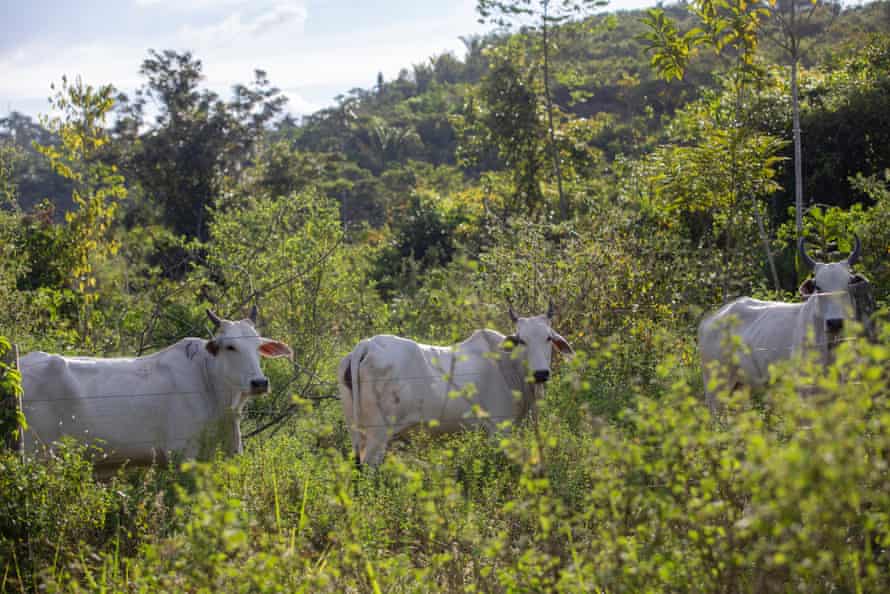
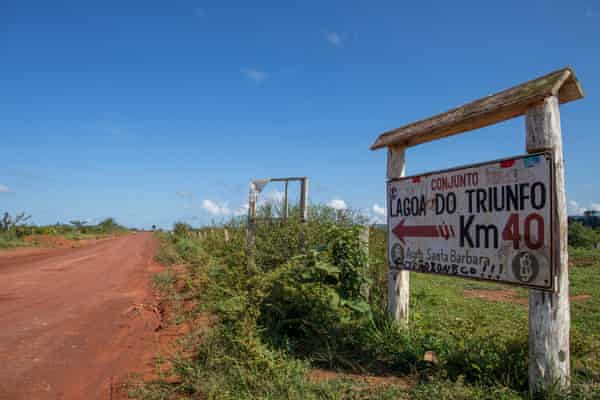
The cows grazed under the midday Amazon sun, virtually a wooden span spanning a river. It was an idyllic scene of pastoral quiet, occasionally broken by a motorbike growling on the dirt road that cuts through part of the Lagoa practice Triunfo cattle farm to a nearby community.
But this pasture is land that the farm has been forbidden to use for cattle since 2010, when it was embargoed by Brazil's government environs agency Ibama for illegal deforestation. Nearby were more signs of fresh pasture: short grass, feeding troughs, and table salt for cattle.
The vast 145,000-hectare (358,302-acre) farm is i of several owned by the company AgroSB Agropecuária SA – known in the region as Santa Bárbara. Located in an environmentally protected surface area, Lagoa do Triunfo is more than 600km (372 miles) from the majuscule of the Amazon state of Pará on the western fringes of Brazil'southward "agricultural frontier" – where farming eats into the rainforest. To go there takes hours of driving forth dirt roads and a ferry ride from nearby São Félix practise Xingu, a cattle town accessible only past plane until a few decades agone.
AgroSB supplies cattle to JBS, the world'due south biggest meat packing company and single biggest supplier of beef, chicken and leather globally, with 350,000 customers in more than 150 countries.
A articulation investigation by the Guardian, Repórter Brasil and the Bureau of Investigative Journalism establish that during 2018, the Lagoa do Triunfo farm delivered hundreds of heads of cattle to other farms also endemic by AgroSB for fattening. Cattle was sent from those farms to slaughter in JBS plants.
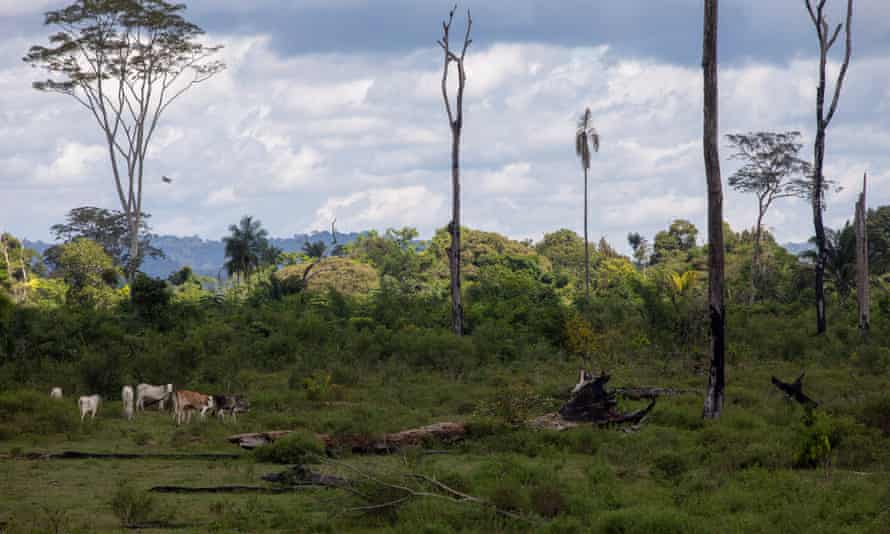
Embargos are imposed for ecology violations, such equally farmers or landowners cutting downward copse and deforesting illegally, and serve both as a penalty and protective measure to let state to recover. Between 2010-2013 at least 12 areas of land on Lagoa practice Triunfo were embargoed, and Ibama fined AgroSB more $18m (£14m) – at current rates – for deforestation on the Lagoa do Triunfo subcontract.
Our investigative squad visited country conspicuously demarcated as embargoed on government websites, and found cows grazing at that place. A farm worker said cattle were allowed to roam in areas employees knew were embargoed. "You can't cutting downward the vegetation," the employee said. "The vegetation grows and we piece of work the cattle inside." The Guardian is withholding their proper noun in case of retaliation.
Work past NGO Trase, seen exclusively by our team, this week reveals the extent to which the international demand for beefiness is driving deforestation, with thousands of hectares of Amazon being felled every year to provide meat for world markets.
AgroSB is a powerful farming empire owned by the Opportunity group, co-founded by Daniel Dantas, a controversial man of affairs Bloomberg described as the "bad boy" of Brazilian finance. Information technology owns half a 1000000 hectares across Pará and has long attracted controversy. Over the past decade, AgroSB has been accused of illegal deforestation, keeping workers in slave-like conditions, and spraying a customs occupying one of its farms with pesticides – accusations information technology has strongly denied.
Scandal has also surrounded JBS, which is supplied past AgroSB. In 2017, following an Ibama investigation, the meat company was fined $7.7m for buying cattle from farms with embargoed areas, including another subcontract owned past AgroSB. The company pledged to terminate buying cattle from the subcontract.
That same year, Joesley Batista, CEO of its controlling company, almost brought downward the government of President Michel Temer afterward secretly recording him appearing to endorse bribery – Temer was indicted but never tried and has always denied the charges, challenge the recording was edited. Joesley and his brother Wesley, then JBS CEO, admitted an all-encompassing web of bribery in a plea bargain bargain.
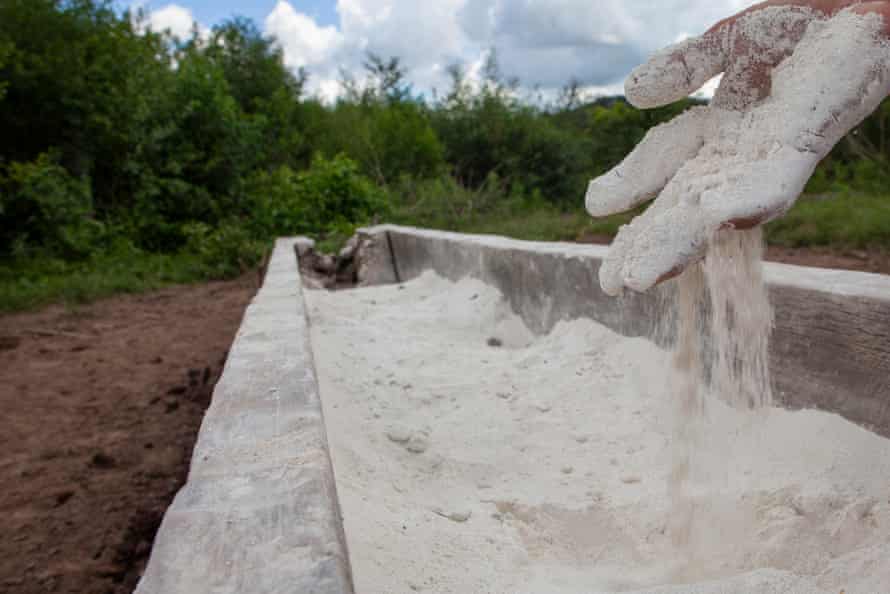
In an email, a spokesman for AgroSB said whatever deforestation had occurred before the company acquired Lagoa practice Triunfo in 2008. "AgroSB does not comport out deforestation in gild to increase its expanse, but rather it recovers degraded areas. This brings social and environmental progress for all, considering in the same area it is possible to produce more than, without deforestation, in respect to the environment," the spokesman said.
"AgroSB's business model is anchored in the acquisition of degraded open and pastured areas, which are fertilised, reclaimed and transformed into high-intensity pastures or grain plantations – which increases food product per hectare and too captures carbon dioxide (CO2) of the atmosphere in the plantations and in more than 250,000 hectares of forests (legal reserve) maintained on its properties." He pointed out that: "In that location is no irregularity in the marketing/transfer of livestock."
He said just 7% of the farm was embargoed, and added that as AgroSB have been successful in appealing against some of the other embargos on their land, the company believes it will also overturn the embargos on Lagoa do Triunfo.
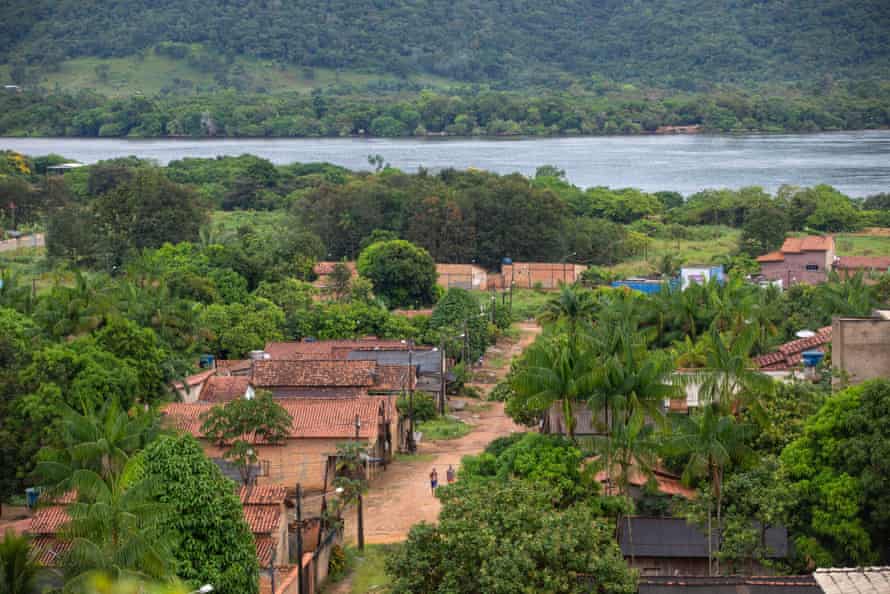
The 'wild west' fringe of the Amazon rainforest
With a population of 125,000 and more than than two one thousand thousand cattle, the town of São Félix practice Xingu covers an area bigger than Scotland. Cattle farming fed its growth from remote Amazon outpost to busy town, and there are clear signs of wealth here.
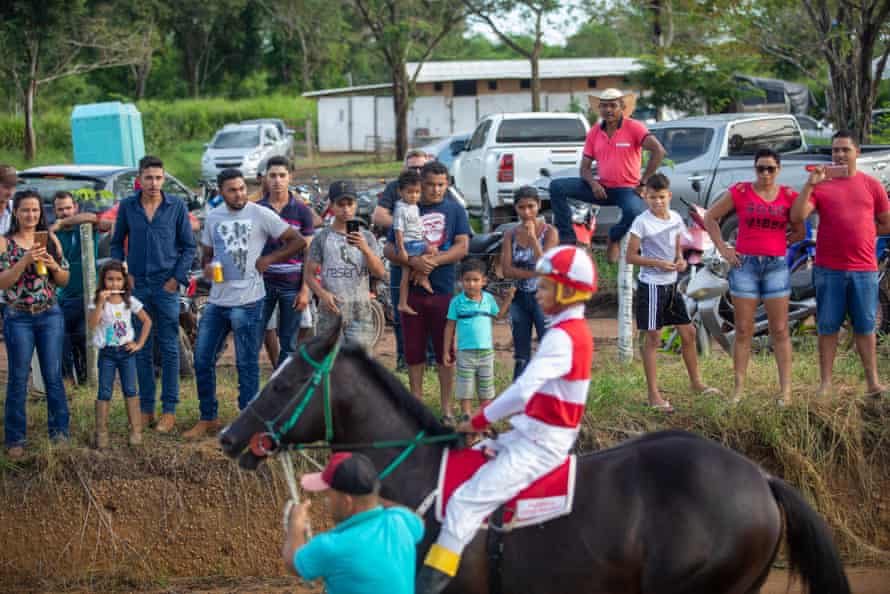
Just outside boondocks, big money was being splashed at a horse racing meet in a field full of 4x4s. Equally 2 jockeys spurred their horses down the rudimentary race track, a commentator bellowed and men waved wads of greenbacks as their bets came in.
There was more than $35,000 in prizes over two days of racing, said Valdiron Bueno, owner of two agricultural supplies shops and the race organiser. Bueno built his business concern more than xx years afterward arriving here with merely the wearing apparel on his dorsum. "It wasn't easy. I cried a lot," he said.
São Félix practise Xingu was mostly forest when Arlindo Rosa, now president of the town'southward spousal relationship of rural producers, arrived in 1993. "At that place was practically none of this farming … there was no highway, there was nothing," he said. "People came from exterior with the spirit to raise cattle," said his vice-president, Francisco Torres, who arrived in 1987.
Both men were critical of what they saw every bit overzealous ecology controls. Torres criticised Ibama as a "fines industry", borrowing a phrase from President Jair Bolsonaro, who has dismantled environment protection and enjoys back up from farmers like these. "How are you going to work if yous tin can't deforest an expanse, principally a modest one?" said Rosa.
But the embargos do not appear to have affected AgroSB'due south business organisation, the Guardian and Réporter Brasil investigation found.
A JBS spokesman said: "The facts pointed out exercise not correspond to the standards and processes adopted past the Company", indicating an independent 2018 audit that showed that "more than 99.9% of JBS's cattle purchases meet the company's socio-environmental criteria and the 'Public Livestock Commitment'" – a deal signed betwixt big cattle companies and Greenpeace in 2009. It was followed in 2011 by an agreement JBS and other meat companies signed with federal prosecutors not to purchase cattle directly from embargoed or illegally deforested areas.
A spokesman told the Guardian via email: "JBS has a responsible purchase policy for raw materials and does not buy animals from farms involved in deforestation of native forests, invasion of indigenous reserves or environmental conservation areas, or that are embargoed past the Brazilian Institute of Surroundings and Renewable Natural Resource (Ibama)."
The contained audit found the company had made impressive progress in tightening up procedures and shutting out farms with areas embargoed by Ibama. However, although the arrangement excludes farms that take embargoed areas, the audit noted that other farms owned past the same company may notwithstanding sell to JBS. Information technology ended that: "Indirect suppliers of cattle to JBS are not yet checked systematically, since JBS has not yet managed to adopt auditable procedures for its indirect suppliers."
Official country documents seen past the Guardian and Repórter Brasil show that from January to October 2018, Santa Bárbara delivered at to the lowest degree 296 cattle from the Lagoa do Triunfo farm to its Espiríto Santo subcontract in Xinguara, in the same state.
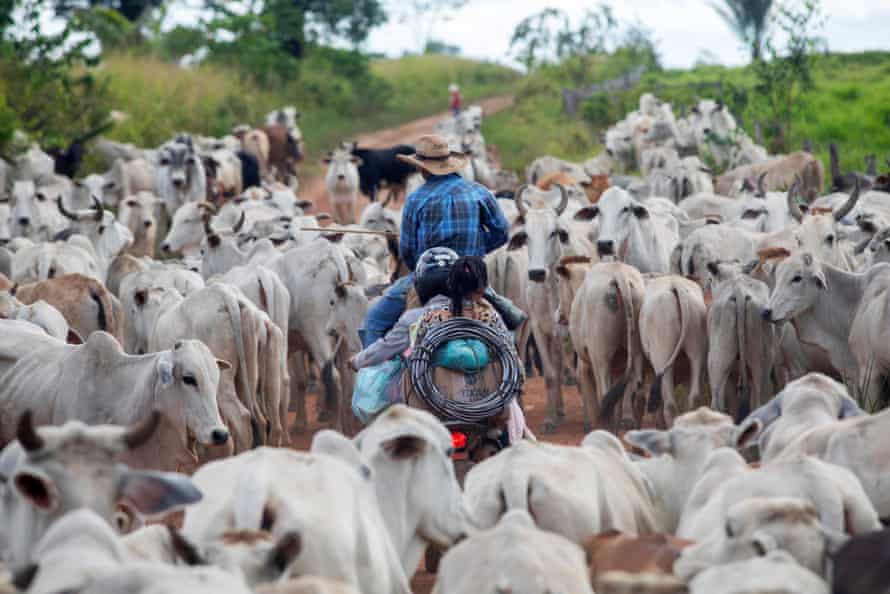
Betwixt July and December 2018, Santa Bárbara sent least ane,977 cattle from the Espiríto Santo farm to two JBS slaughterhouses in Pará. In January at least 936 cattle were sent from the Espírito Santo farm to JBS'due south slaughterhouse in Redenção in Pará.
Throughout 2018, Santa Bárbara also sent at least 729 cattle from the Lagoa do Triunfo subcontract to exist fattened at its Porto Rico farm in Xinguara. In Apr 2018, 36 cattle from the Porto Rico farm were sent to slaughter at JBS'south establish in Tucumã in Pará.
Growing international need for beef has become a fundamental driver in the destruction of the Amazon rainforest, with new figures seen by our squad revealing the full extent of deforestation directly linked to a handful of major nutrient corporations. Beef linked to deforestation is exported globally, including to central markets in the east asia and Europe.
An investigation by Trase has uncovered how up to 5,800 sq km of forest is existence felled in the Amazon and other areas annually to exist converted into pasture used for cattle farming, with livestock from deforested areas constitute to be supplying abattoirs producing beef for global markets.
Companies in JBS's supply concatenation are potentially responsible for the destruction of betwixt 28,000 and 32,000 hectares (280-320 sq km) of forest each year for exported beef, according to data assembled past Trase. At that place is no proffer Lagoa practice Triunfo beef is exported. AgroSB land that they purchased the land in 2008, after the deforestation had already happened. JBS points out that it has "one of the largest individual supplier monitoring systems in the world… which covers the legal Amazon region." It has been working on the GTA-Verde concept, which would cover all links in the supply concatenation and "foreclose the entry of cattle from illegally deforested areas into the meat industry".
The latest data shows that deforestation in the Brazilian Amazon has been on the rise since 2012. Between Baronial 2017 and July 2018, about vii,900 sq km was destroyed.
In the virtually comprehensive study of its kind ever produced, Trase used customs, agricultural, sanitary inspection, and deforestation data to map Brazilian cattle exports from the international markets which swallow them back to the more than 3000 municipalities where the cattle were raised. Trase is an independent supply-chain transparency initiative, developed by the Stockholm Surroundings Institute and the Uk-based NGO Global Canopy.
The assay includes information on "indirect" suppliers, which are ofttimes intermediate farms that don't sell directly to abattoirs, merely supply other farms which may truck cattle to slaughter. This is a "previously invisible" role of the beef concatenation, say researchers, which is non monitored for deforestation risks.
The supply chain "map" was then cross-referenced with official datasets on pasture expansion, deforestation rates and figures on regional cattle product in order to calculate a deforestation "chance" associated with specific companies and the primary international consign markets.
Considering of the high volume of Brazilian beef shipped to Mainland china and Hong Kong, these markets are associated with the highest corporeality of deforestation in total – between 17,400 and 26,400 hectares per year – according to the analysis. The EU also imports more than than $600m worth of beefiness from Brazil each year. And that will increment if the EU and member states corroborate a new trade deal with Brazil, Uruguay, Argentina and Paraguay to gradually let 99,000 tonnes of low-tariff South American beefiness into Europe every year.
Erasmus zu Ermgassen, lead researcher at Trase, said that while some slaughterhouses monitor their direct suppliers, none monitor their indirect suppliers. "There is enormous potential to use land more efficiently and sustainably in the Brazilian beef sector, and to meliorate rural livelihoods by investing in cattle ranching on existing pasturelands."
-
This article was amended on Monday 8 July to right the figures for deforestation associated with China and Hong Kong.
Source: https://www.theguardian.com/environment/2019/jul/02/revealed-amazon-deforestation-driven-global-greed-meat-brazil
0 Response to "Deforestation in the Amazon From Beef"
Post a Comment