Number of Beef Cows in Brazil

Cattle in Rio Grande practise Sul
In Brazil, the lords of Casa da Torre de Garcia d'Avila pioneered the livestock manufacture, often using indigenous labor as cowboys. However, a great drought in the Northeast and the discovery of precious minerals in Minas Gerais at the end of the 18th century moved the cattle ranch in Brazil to the Southeast and South, more specifically São Paulo and Rio Grande exercise Sul.
In 2017, the flocks in Brazil were of the post-obit order: ane,425,699,944 birds, with 242,767,457 chicken and 15,473,981 quail; 214,899,796 cattle, 41,099,460 pigs, 17,976,367 sheep, 9,592,079 goats and ane,381,395 buffaloes, in addition to 5,501,872 equine.[ane]

Castelo de Garcia d'Avila
Cattle [edit]
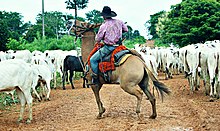
Brazil is the holder of the second largest herd of cattle in the world, 22.2% of the world herd, behind simply Republic of india, which does not produce them for consumption. The state was as well the second largest producer of beef, responsible for fifteen.4% of global product. The United states of america (the world's largest producer), Brazil and the European Union, together, deemed for almost half of all meat produced in the earth in 2016. In 2016 Brazilian beef exports in natura totaled 1.08 one thousand thousand tons with a value of R $4.35 billion.[two]
The Brazilian cattle herd had 218.23 million head in 2016. The main cattle ranching center in Brazil is the state of Mato Grosso, the largest cattle herd in Brazil. In 2016, the Central-Westward Region had 34.iv% of the national total. The North Region registered 47.98 1000000 head of cattle, the 2nd largest in the country. Mato Grosso was the state with the largest cattle herd, housing 13.9% of the Brazilian total. At the time, the country had xxx.thirty meg head of cattle. Minas Gerais, Goiás and Mato Grosso do Sul contributed 10.viii%, x.5% and 10.0% of the national staff, respectively. At the municipal level, the largest numbers were located in São Félix do Xingu (PA), Corumbá (MS), Ribas do Rio Pardo (MS), Cáceres (MT) and Marabá (PA). Among the 20 municipalities with the largest herd, 13 were located in the Midwest, six in the N, and 1 in the South of the country.[two]
Brazil in 2018 was the 3rd largest world producer of milk, backside only the United States and India. This year, the country produced 35.1 billion liters.[three]
The S region holds the first identify in the ranking in Brazilian milk production. The South has 35.vii%, competing with the Southeast (which was the largest producer until 2014), which has 34.ii%. The Southeast has the largest herd of milked cows: xxx.4% of the total of 17.1 million existing in Brazil. The highest productivity, however, is that of the South Region, with an average of 3,284 liters per cow per year, which is why it leads the ranking of milk product since 2015. The municipality of Castro, in Paraná, was the largest producer in 2017, with 264 meg liters of milk. Paraná is already the second largest national producer with 4.seven billion liters, second only to Minas Gerais. Minas Gerais is the main milk producing land in Brazil, with the largest number of milked cows, responsible for 26.six% of production and twenty.0% of total milking animals. The municipality of Patos de Minas was the 2nd largest producer in 2017, with 191.3 million liters of milk. In 2015, the state produced 9.1 billion liters of milk.[iv] [5]
Pigs [edit]

In 2019, Brazil was the 4th largest pork producer in the world, with almost four million tons, later People's republic of china, the European Spousal relationship and the United States.[6]
For pork, the three southern states are the largest producers in the land. Brazil had 41.1 million caput in 2017. Santa Catarina is the largest producer in Brazil, with 19.7% of the Brazilian total. The state is responsible for 28.38% of the state's slaughter and for 40.28% of Brazilian pork exports. Paraná (17.2%) and Rio Grande do Sul (14.6%) are the 2nd and 3rd largest producers. Toledo (PR), Rio Verde (Get) and Uberlândia (MG) are the cities with the highest numbers of pigs.[one] [7]
Poultry [edit]

Brazil is the world'south largest exporter of chicken meat: 3.77 million tons in 2019.[eight] [9]
The Brazilian poultry flock, in 2018, was of the order of i.5 billion heads. Poultry flocks, co-ordinate to IBGE, include chickens, roosters, hens and chicks. In 2018, the South region, with accent on the creation of chickens for slaughter, was responsible for almost half of the Brazilian total (46.nine%). Paraná alone accounted for 26.2%. The situation is reversed, however, when it comes to chickens. The first region in the ranking was the Southeast, with 38.nine% of the country's total head. A total of 246.nine one thousand thousand hens were estimated for 2018. The state of São Paulo was responsible for 21.9%. Santa Maria de Jetibá (ES) was the municipality that had the largest numbers of both chickens and chickens. For the ranking of chickens came Cascavel (PR), Bastos (SP), Rio Verde (Become) and Uberlândia (MG). The ranking of municipalities for chickens is completed by Bastos (SP), Primavera do Leste (MT), São Bento practise Una (PE) and Itanhandu (MG). In 2017, the primary poultry producing states were Paraná (25.3%), São Paulo (14.0%), Rio Grande do Sul (11.0%), Santa Catarina (10.8%). In terms of chickens, in 2017 in that location were 242.8 1000000 heads: Southeast (38.7%) and Due south (26.0%), the largest producers. Among united states of america, São Paulo led with 21.nine%, followed by Paraná (x.1%), Rio Grande practise Sul (eight.eight%), Minas Gerais (eight.7%) and Espírito Santo (7.9%).[10] [11]
In 2016, Brazil was the 7th largest egg producer in the world.[12]
Brazilian production of craven eggs was 4.4 billion dozens in 2018, generating an income of R $14.0 billion. The Southeast Region had 43.8% of this total. The South comes in 2nd identify, with approximately 24% of product. The land of São Paulo was the largest national producer (25.6%). Paraná comes in 2nd place with approximately 10%. Amongst the municipalities, the largest producers are the cities of Santa Maria de Jetibá (ES), Bastos (SP) and Primavera do Leste (MT).[13] [xiv]
In 2018, the Brazilian population of quails was xvi.8 one thousand thousand birds. The Southeast is responsible for 64%. São Paulo (24.6%) and Espírito Santo (21.0%) are the largest producers. In the municipal ranking, Santa Maria de Jetibá (ES) occupies the first position both in the quantity of animals and in the production of eggs. Bastos (SP) was in 2d position.[15]
Goats and sheep [edit]

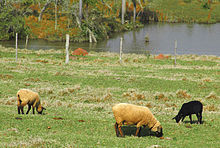
Sheep in the farthermost southward of Brazil
The Northeast Region housed 93.two% of the caprine animal herd (8,944,461 heads) and 64.2% of the sheep herd (11,544,939 heads) in 2017. Bahia concentrated thirty.9% of the caprine animal herd and 20,9% of the national sheep herd. Casa Nova (BA) took outset identify in the municipal ranking with the largest numbers of both species. The Southward region was the 2nd largest in the country in the herd of sheep, with 4.2 million heads. Sheep shearing activity remained predominant in the South, which is responsible for 99% of wool production in the land. Rio Grande do Sul continued to be the state with the largest national participation, representing 94.1% of the full. The municipalities of Santana do Livramento, Alegrete and Quaraí led the activity. Currently, meat product has get the main objective of sheep farming in Rio Grande do Sul, due to the increment in prices paid to the producer that made the activity more attractive and assisting. There, sheep breeds more adapted to the subtropical climate are used.[sixteen] [17]
In 2016, Brazil had a goat herd of almost 9.viii million heads. The country has the 21st largest herd in the globe. However, the Brazilian herd is mostly establish in an area with unfavorable climatic weather (in the semi-arid region of the Northeast), and goat farming is rarely seen as a business activeness and is oft considered a marginal action, used only for survival, non on a commercial scale.[18]
Pisciculture [edit]
In fish farming, western Paraná, in municipalities shut to Toledo and Cascavel, became the largest fish producing region in the country, with tilapia as the main cultivated species. The west represents 69% of all product in Paraná, the largest national producer, with 112 thousand tons. Of this amount, 91% refer to tilapia breeding.[19]
The country's fish production totaled 485.ii thou tons in 2017. Paraná (20.2%), São Paulo (9.8%) and Rondônia (8.2%) had the largest participation. The city of Nova Aurora led the national product. Tilapia, with 283.two thousand tons, represented 58.4% of fish farming. Tambaqui, with 18.2%, is the 2d most created species. The Due north Region is the largest producer of tambaqui.[1]
The product of shrimp in Brazil was 41.0 yard tons in 2017. Rio Grande do Norte (37.7%) and Ceará (28.9%) were the largest producers. Aracati, in Ceará, was the urban center with the largest participation.[1]
The production of oysters, scallops and mussels was 20.9 thousand tons in 2017. Santa Catarina has 98.one% of the national product. Palhoça, Florianópolis and Bombinhas were the municipalities with the highest product.[1]
Honey [edit]
In 2017, Brazil was the 11th largest producer of honey in the world, with less than 4.0% of global exports of the product. 41.6 grand tons were produced, 16.5 thousand tons in the South Region.[20]
The South region was the main honey producer in the country in 2017, accounting for 39.7% of the national full. Rio Grande practice Sul was the 1st with 15.2%, Paraná in 2nd with 14.three%, Santa Catarina in 5th with 10.ii%.[21]
Buffaloes [edit]

In 2016, the Brazilian herd of buffaloes was i.37 million head. The North Region full-bodied 66.2% of buffalo farming, while the residual was distributed betwixt the Southeast (12.7%), Northeast (ix.5%), South (vii.4%) and Key-West (4,4%). Pará was responsible for 37.9%, followed by Amapá (21.vi%), representing together 89.9% of the herd in the North Region and 59.5% of the national herd. Of the ten municipalities with the largest numbers, half-dozen are in Pará and four in Amapá. In municipal terms, the start position was with the Municipality of Chaves (PA), with 160.85 thousand animals, followed by Cutias (AP) and Soure (PA).[2] In Minas Gerais, at that place has been an increase in the production of buffaloes for meat and dairy production, mainly mozzarella fabricated with buffalo milk.
Raniculture [edit]
In 2016, Brazil was considered the 2nd largest frog breeder in the earth, second only to Taiwan. However, it is modest, without even precise information most the quantity produced: the concluding official survey cited 160 tons per year, merely some say that this number is three times higher. Because the price of a kilo of frog meat is high, consumption is reduced and reserved for a very few people.[22] Frog meat is easy to digest, has high nutritional value, low fat content and depression cholesterol, and besides is considered a gastronomic effeminateness. Some nutritionists consider frog meat to be the best poly peptide available for consumption.[23]
Duck [edit]
In Brazil, duck meat production is full-bodied in Santa Catarina. Information technology is low-volume, aimed at a niche marketplace. In 2015 the state exported Usa$7,637 million of this meat, mainly to Saudi Arabia, United Arab Emirates and Nihon. At the time, the largest company in the region specializing in this meat slaughtered about 10,000 ducks a day.[24]
Encounter likewise [edit]
- Agriculture in Brazil
References [edit]
- ^ a b c d due east PPM 2017: Rebanho bovino predomina no Centro-Oeste e Mato Grosso lidera entre bone estados
- ^ a b c IBGE: rebanho de bovinos tinha 218,23 milhões de cabeças em 2016
- ^ Brasil é o 3º maior produtor de leite practise mundo, superando o padrão Europeu em alguns municípios
- ^ Produção de leite cai 0,5% e totaliza 33,5 bilhões de litros em 2017
- ^ REGIÃO SUL Do BRASIL É O MAIOR CENTRO PRODUTIVO DE PROTEÍNA Fauna DO MUNDO
- ^ principais países produtores de carne suína entre 2017 e a estimativa para 2019
- ^ REGIÃO SUL Exercise BRASIL É O MAIOR CENTRO PRODUTIVO DE PROTEÍNA ANIMAL Practise MUNDO
- ^ Conheça os 3 países que desafiam o Brasil nas exportações de frango
- ^ maiores exportadores de carne de frango entre os anos de 2015 due east 2019
- ^ Equally cidades brasileiras com o maior número de aves
- ^ PPM 2017: Rebanho bovino predomina no Centro-Oeste due east Mato Grosso lidera entre bone estados.
- ^ Brasil é sétimo maior produtor mundial de ovos
- ^ As cidades brasileiras com o maior número de aves
- ^ PPM 2017: Rebanho bovino predomina no Centro-Oeste e Mato Grosso lidera entre os estados.
- ^ As cidades brasileiras com o maior número de aves
- ^ PPM 2017: Rebanho bovino predomina no Centro-Oeste e Mato Grosso lidera entre os estados
- ^ O Rio Grande do Sul é o segundo estado com o maior rebanho de ovinos do Brasil
- ^ Evolução Anual do Efetivo de Rebanho de Caprinos
- ^ REGIÃO SUL DO BRASIL É O MAIOR CENTRO PRODUTIVO DE PROTEÍNA Brute Exercise MUNDO
- ^ EVOLUÇÃO DA PRODUÇÃO DE MEL NA ÁREA DE ATUAÇÃO DO BNB
- ^ PPM 2017: Rebanho bovino predomina no Centro-Oeste e Mato Grosso lidera entre bone estados
- ^ Brasil é segundo maior criador de rãs do mundo
- ^ Carne de rã seria a "melhor proteína", segundo "nutricionista sarada": como ela come up?
- ^ Produtores trocam frangos por patos
Source: https://en.wikipedia.org/wiki/Animal_husbandry_in_Brazil
0 Response to "Number of Beef Cows in Brazil"
Post a Comment